Culture · 5 min read
Why Does Vietnamese Food Lag Behind Thai Globally, Despite Being More Diverse?
Vietnamese cuisine is roughly as old as Thai, arguably more varied across its three regions, and equally adaptable. Yet a random American suburb has five Thai restaurants and one phở place. The gap isn't about quality. It's about strategy, timing, and a few factors nobody talks about.
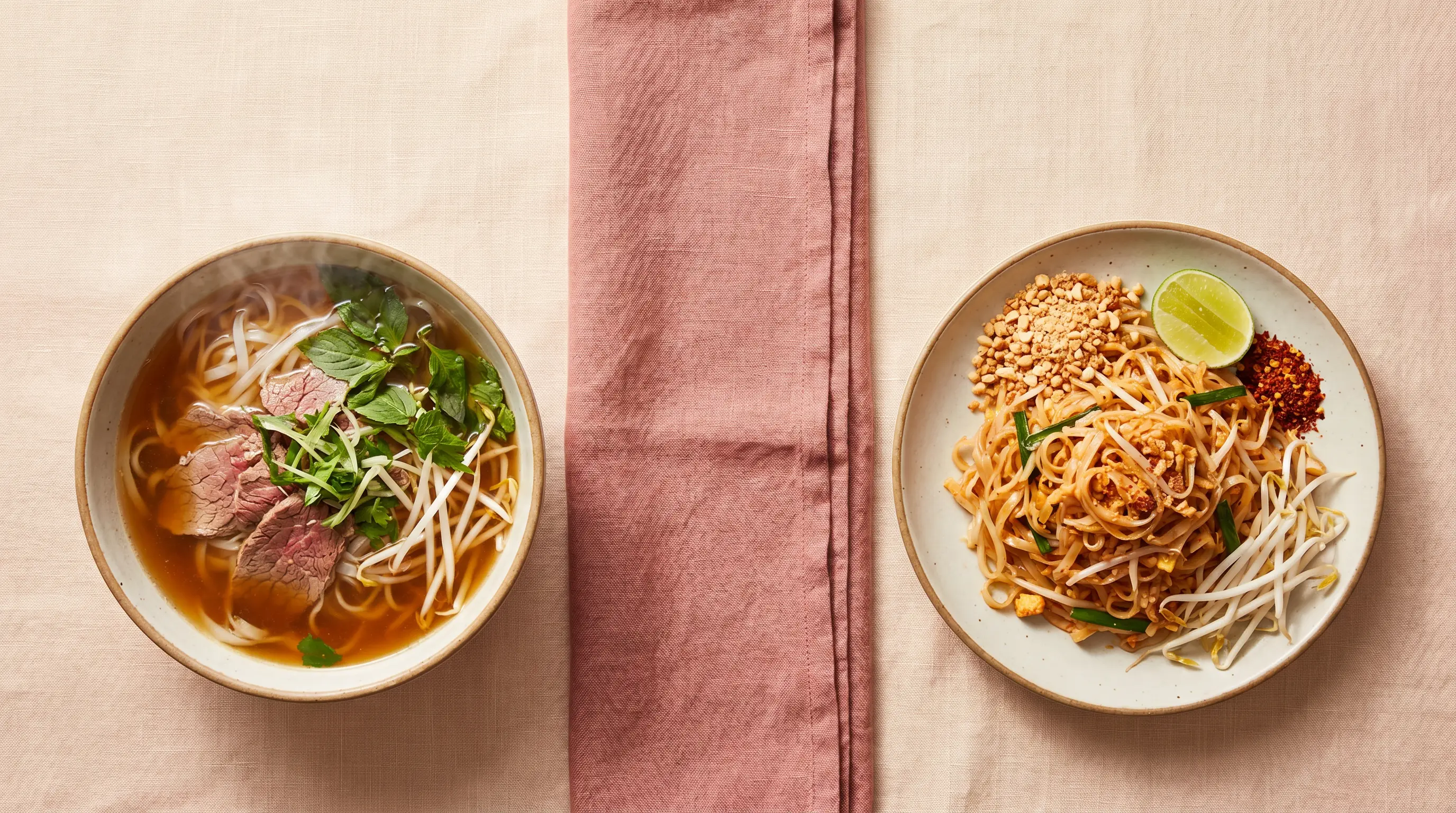
Thailand had a strategy
In 2002, the Thai government launched the Thai Kitchen of the World initiative — a coordinated effort to grow Thai restaurants abroad as a form of soft power. The program offered subsidized loans, chef training, ingredient export support, and even certification for "authentic" Thai restaurants. Within a decade, Thai restaurants outside Thailand roughly doubled.
Vietnam has had no equivalent program. The Vietnamese government doesn't view restaurant proliferation as a strategic asset the way Thailand does. So Vietnamese cuisine has had to spread organically, restaurant by restaurant, mostly through diaspora cooks.
The refugee timing
Vietnamese cooking arrived in the West in big waves after 1975, brought by refugees who often lacked capital and credentials. Many of those families opened phở shops because phở could be made affordably at scale, but they didn't have the resources to franchise or to influence broader food culture.
Thai immigration to the West was different — slower, more economically diverse, and concentrated in cities where Thai food could attract a curious, well-off audience earlier. Both communities deserve their place in American food culture. They just got there by different paths.
The herbs-don't-travel problem
Vietnamese cuisine leans hard on fresh herbs that don't ship well: Thai basil, sawtooth coriander, perilla (tía tô), rice paddy herb, fish mint, and more. Some of these are still difficult to source in American grocery stores in 2026.
Thai cuisine relies on fewer fresh-herb varieties — Thai basil, cilantro, and that's mostly it. The rest is pantry: fish sauce, coconut milk, curry pastes, palm sugar. Pantry ingredients travel. Fresh-herb-dependent cuisines are constrained by supply chains.
The "one dish" problem
If you asked a random non-Asian American to name three Thai dishes, they'd say pad thai, green curry, tom yum. If you asked them to name three Vietnamese dishes, you might get pho, banh mi, and a long pause.
Vietnam's culinary heritage is actually deeper. Northern pho, central Hue cuisine (with bún bò Huế and complex royal dishes), southern khmer-influenced cooking, and a vast street-food culture — but the global brand consolidates around two or three dishes. That's a marketing failure, not a cuisine failure.
The diaspora size
There are roughly twice as many Thai people abroad as Vietnamese people abroad, on a population-normalized basis. More diaspora, more restaurants. Simple math.
It's worth noting that Vietnamese-American restaurants are concentrated in specific regions — California, Texas, the Pacific Northwest — while Thai restaurants spread more evenly. That regional concentration also limits brand-building.
Why this might be changing
Vietnamese cuisine has been having a moment for about a decade now. Newer Vietnamese chefs — Eric Banh, Helene An, Charles Phan, and a younger cohort coming out of Brooklyn and Los Angeles — are doing the elevation work the Thai government once funded. Anthony Bourdain spent serious airtime championing Vietnamese cuisine before his death. The James Beard Awards have caught up.
The gap will narrow. But it'll narrow slowly. Food cultures take a long time to shift.
What we're trying to do
Our role is small: serve a complete Vietnamese menu — twenty-two phở variants, vermicelli, lomein, rice plates, chef specialties — at two kitchens in Salt Lake County and a food truck at the University of Utah. We're not waiting for a government program. We're cooking the food.
Come see the full breadth of what Vietnamese cuisine actually offers, or visit us at Taylorsville or West Jordan.