Technique · 5 min read
Why Restaurant Pho Tastes Different Than Home Pho (Even With the Same Recipe)
You followed the recipe. You charred the ginger. You used Phu Quoc fish sauce. The broth at home still tastes thinner, softer, less alive than the bowl you had last Saturday at a restaurant. That gap is real, and it's not in your head. It's mostly volume, time, and three or four variables almost no recipe spells out.
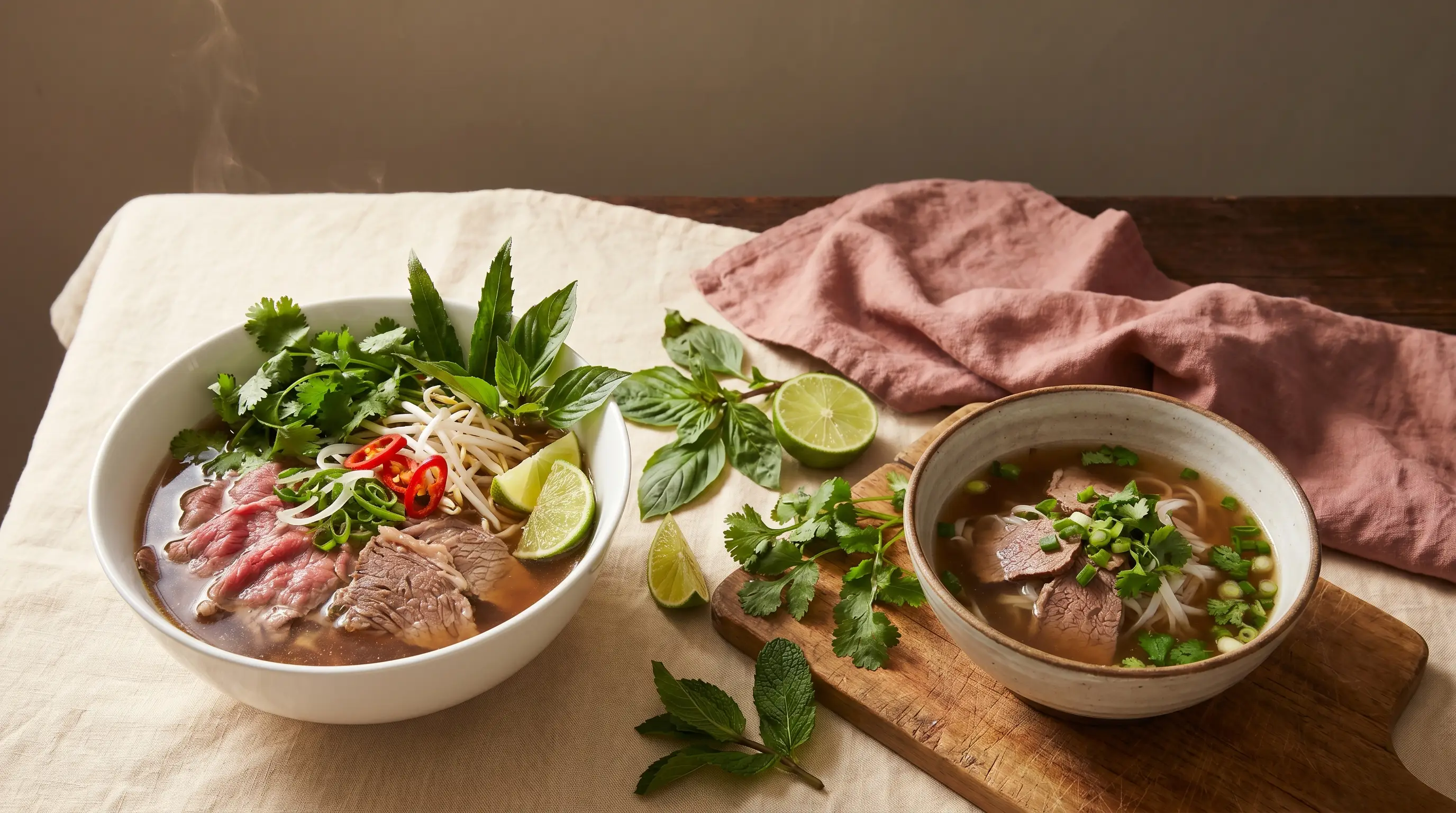
The volume argument
A home pho pot holds eight to twelve quarts. A restaurant pot holds fifty-plus liters. That's not just more soup. Larger volumes simmer differently — the ratio of surface area to liquid changes, so evaporation, foam formation, and gelatin extraction all behave differently. Big pots also stabilize at lower, more even temperatures.
The gelatin point matters most. A restaurant simmers fifteen pounds of beef bones in fifty liters. The home version simmers two pounds in twelve quarts. The proportions are roughly the same, but the surface-to-volume ratio isn't, and gelatin extraction is non-linear. The big pot makes a glossier, more body-forward broth on the same time clock.
The time argument
Most home recipes say "simmer four to six hours." Real restaurant pho simmers ten to twelve, sometimes more. The difference between hour four and hour twelve isn't just stronger flavor — it's a chemical transition. Collagen finishes breaking down. Marrow fully releases. The broth crosses from "beef-flavored water" to "beef extract."
If you ever wonder why a home stockpot's broth tastes one-dimensional even after a long simmer, the answer is often that it never got hot enough for long enough at a constant temperature. Home stoves cycle; restaurant burners hold.
The skimming argument
Watch a Vietnamese auntie make pho. For the first two hours, every twenty minutes she pulls foam off the top. Then every hour for the next four. By the time the broth is finished, the surface has been disturbed thirty times. The foam she's removing is denatured protein and impurities — and what's left is clear, clean broth.
Home cooks skim once or twice and call it good. The broth ends up slightly cloudy, slightly muddied, slightly off. It's hard to articulate the difference if you can't see them side by side, but you can taste it.
The fish-sauce-not-salt argument
Many home recipes say "salt to taste." Restaurant recipes never do — they salt with Phu Quoc fish sauce and a knob of rock sugar at the very end. Fish sauce delivers salt plus glutamates, which read as savory depth. Plain salt delivers only salt. The difference is enormous in a beef broth.
If your home pho tastes flat, try replacing two-thirds of the salt with fish sauce. You'll get closer.
The MSG question
Some restaurants use MSG. Some don't. Honest pho cooks will tell you that real long-simmered bone broth has more naturally-occurring glutamate than any teaspoon of MSG could add, and the MSG conversation is a distraction. The volume-and-time argument explains most of the gap on its own.
That said: if a restaurant's broth tastes aggressively savory in a way that doesn't match the visible bones-and-bones-and-bones treatment, MSG is likely. That's not a moral failing, just a clue.
What we actually do
At Vietopia we run our pho stockpots overnight, twelve hours minimum. Beef knuckles, marrow bones, oxtail. Aromatics charred over open flame. Spice sachet toasted and bundled. Skimmed every twenty minutes for the first two hours. Salted with Phu Quoc fish sauce and rock sugar at the end. No MSG.
The honest answer to your question is: all of the above, plus volume. You can get close at home. You can't quite get there.
Try a bowl at Taylorsville or West Jordan and compare. All twenty-two pho variants use the same overnight broth.