Culture · 4 min read
Why Bún Bò Huế — Arguably Better Than Phở — Almost Never Breaks Through
Anthony Bourdain called bún bò Huế the greatest soup in the world. Most Vietnamese cooks who've trained in central Vietnam agree it's more layered and harder to make than phở. So why does every American suburb have phở places but no bún bò Huế places? Three concrete reasons — and none of them is about the dish being inferior.
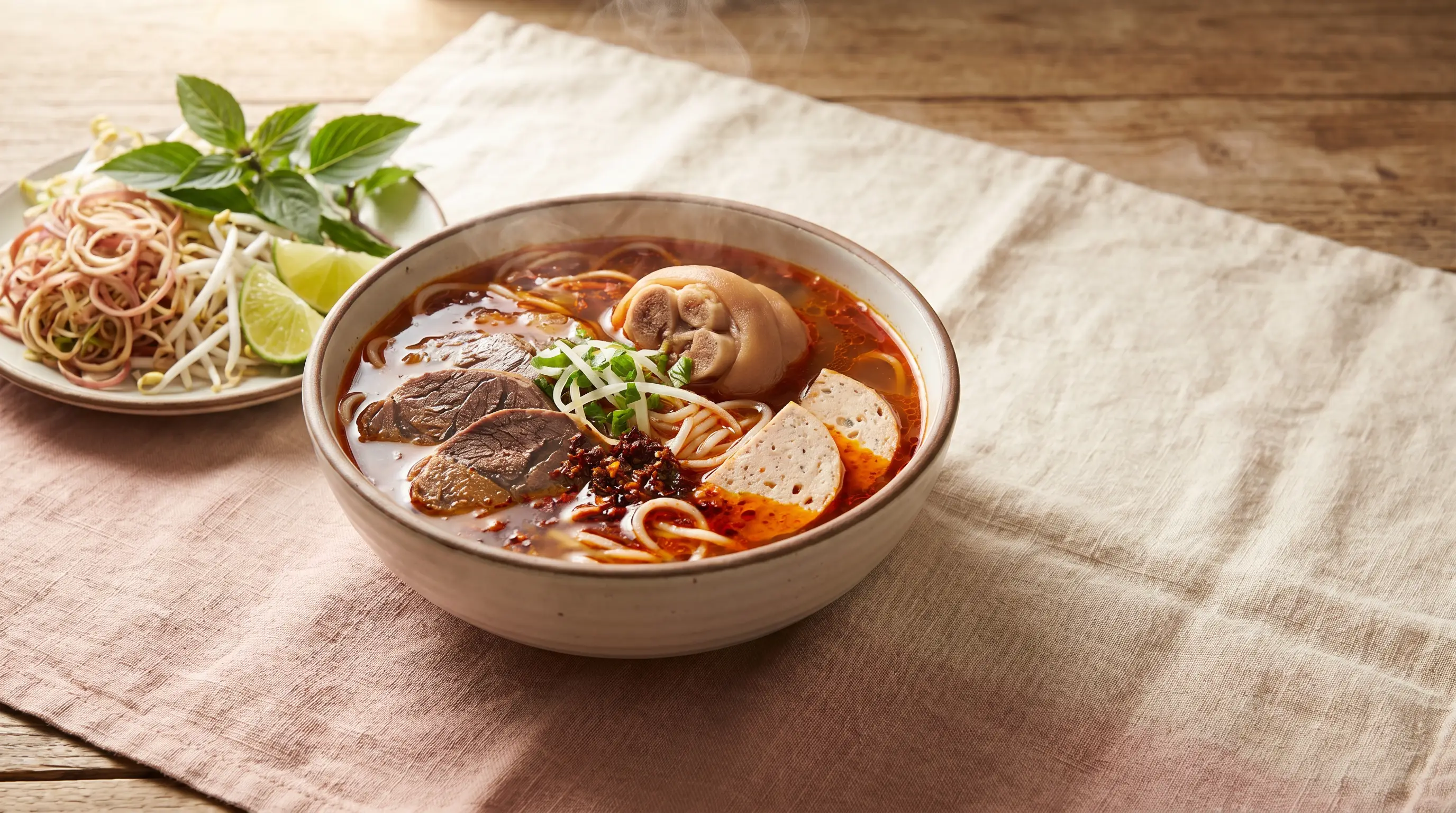
What it actually is
Bún bò Huế is the signature beef noodle soup of Huế, the imperial capital of central Vietnam. The broth is built on beef shank and pork hock, simmered with lemongrass, fermented shrimp paste (mắm ruốc), and a heavy dose of chili oil that gives it its trademark red-orange color. The noodles are round rice noodles, thicker than phở's flat noodles. Toppings traditionally include sliced beef shank, slow-cooked pork hock, Vietnamese pork sausage (chả Huế), and congealed pork blood cubes.
It is spicier, funkier, denser, and more architecturally complex than phở. The flavor profile is sour-spicy-salty-savory-funky, all layered. Phở is a single chord. Bún bò Huế is a chord progression.
The shrimp paste barrier
Mắm ruốc is the soul of bún bò Huế. It's fermented shrimp paste, deeply pungent, the kind of ingredient that fills a kitchen the moment you open the jar. Without it, you have a spicy beef noodle soup. With it, you have bún bò Huế.
For diners not raised on fermented seafood, mắm ruốc reads as off. It's the same barrier that keeps Korean cheonggukjang and Filipino bagoong from being mainstream Western foods. The funk is the point, but the funk is also a wall.
The blood cube problem
Traditional bún bò Huế comes with cubes of congealed pork blood — firm, dark, mild-tasting. They're protein-dense and culturally important. They also look exactly like what they are, and most American diners will not order a bowl containing them.
Many Vietnamese-American bún bò Huế shops omit the blood cubes entirely, or hide them and don't advertise. That's a pragmatic accommodation, but it's also a slight betrayal of what the dish is.
The heat
Authentic bún bò Huế is moderately to seriously spicy — the chili oil floating on top isn't garnish, it's structural. The dish is supposed to make you sweat a little. Phở by contrast is mild and customizable (add chili to taste). The Western diner default is "mild, with hot sauce on the side." Bún bò Huế refuses to play that game.
You can make a milder version. You can. But it isn't bún bò Huế anymore.
The marketing gap
Beyond the dish itself, bún bò Huế had no equivalent of phở's diaspora moment. Phở arrived in the West with Vietnamese refugee waves in the 1970s, got name-recognition through Vietnamese-American restaurants, and crossed over to mainstream menus by the 2000s. Bún bò Huế trailed by twenty years and never had a Vietnamese-American restaurant chain push it the way phở got pushed.
By the time food writers started championing bún bò Huế in the 2010s (Bourdain on Parts Unknown, Andrea Nguyen, J. Kenji López-Alt), the cuisine's English-language brand was already cemented around phở. The newer dish couldn't break through.
Where to actually find it
Bún bò Huế is widely available in California Vietnamese-American communities — San Jose, Westminster, Garden Grove. Less available in the rest of the country. When you do find it, the version is usually accommodated — less mắm ruốc, no blood cubes, a notch less spicy than central Vietnam serves it.
That's not necessarily a bad thing. A well-made accommodated bún bò Huế is still extraordinary. The fully traditional version is a meaningful step further.
What we serve
Our Hot & Spicy Noodle Soup is a bún bò Huế-style preparation: lemongrass-driven beef broth, chili oil, round rice noodles, slices of beef shank, pork hock, and Vietnamese pork sausage. It's a touch milder than central Vietnam's spec but it doesn't dodge the funk or the heat. Come try it at Taylorsville or West Jordan — it pairs well with a Vietnamese iced coffee after.