History · 4 min read
Who Actually Invented Modern Bánh Mì, and When?
Most sources credit Mr. and Mrs. Lê at the Hòa Mã shop in Saigon in 1958. That's the shop that first sold the fully assembled, portable banh mi sandwich. But the ingredients evolved across decades and hundreds of vendors with zero documentation — and most of the food histories hedge for good reason.
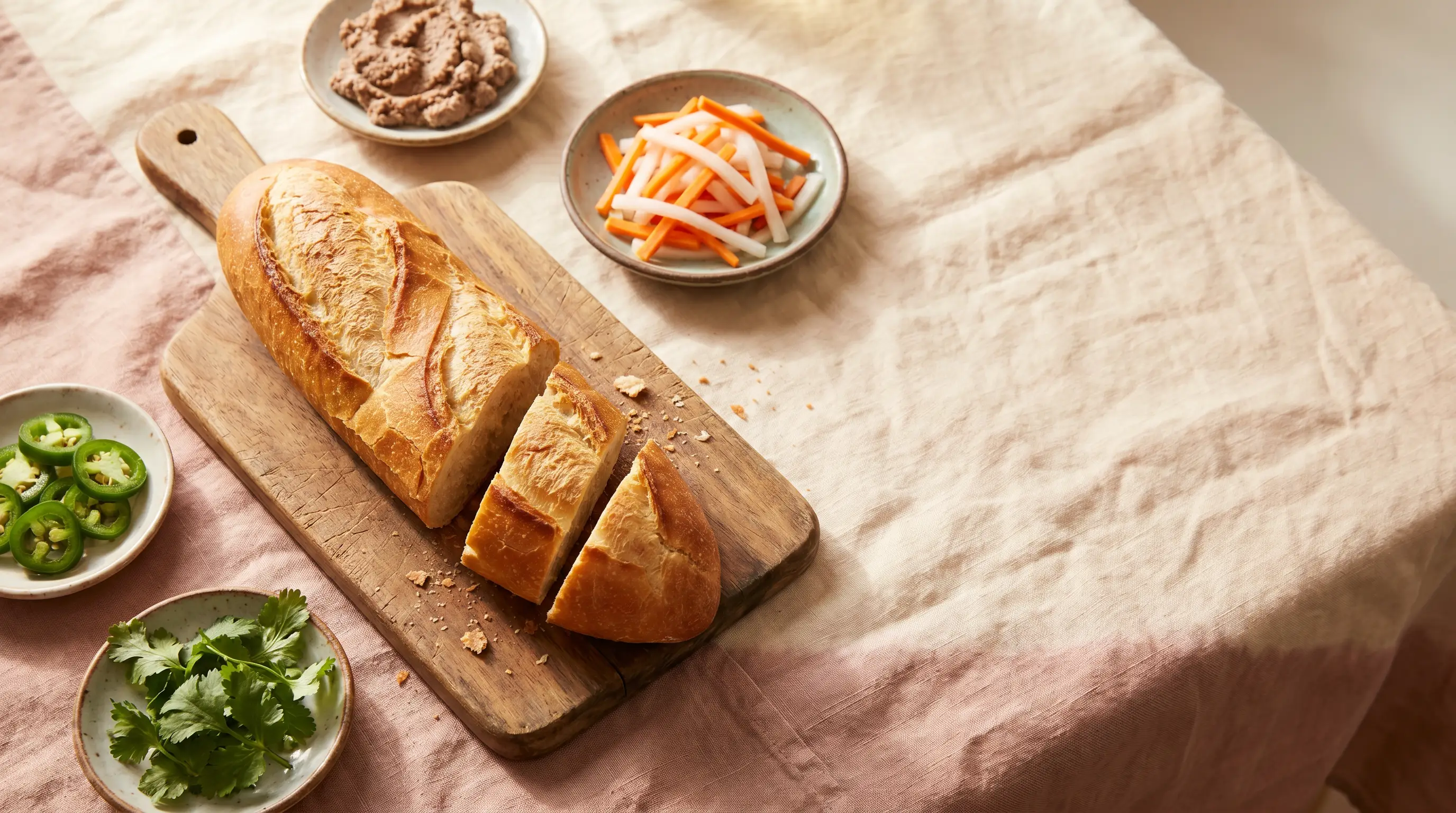
What we mean by "invented"
The banh mi as you know it — the crackling baguette stuffed with Vietnamese cold cuts, pâté, pickled daikon and carrot, cilantro, cucumber, jalapeño, with a smear of mayonnaise or sometimes Maggi — is a 20th-century invention. The components are older. The assembly is newer.
If "inventing" means "first sold the assembled sandwich," the answer is the Lê family at Hòa Mã in Saigon, around 1958. If "inventing" means "first put Vietnamese ingredients on a French baguette," that happened decades earlier, in dozens of places, with no recorded inventor.
The French baguette arrives
French colonization brought the baguette to Vietnam in the 1860s. Early Vietnamese baguettes were dense, expensive, and treated as a French food — eaten with butter, cheese, and pâté. The Vietnamese version we now think of as "banh mi bread" — lighter crumb, crackling crust, often blended with rice flour — emerged in the early-to-mid 20th century as bakers adapted to a hotter climate and cheaper ingredients.
The rice-flour blend matters. It's what gives Vietnamese banh mi bread its specific shatter and lightness. French baguettes don't have it. Cuban bread doesn't have it. It's a distinctly Vietnamese choice.
The filling evolves
Through the 1930s and 40s, banh mi was eaten the French way — split open, butter and pâté inside, maybe ham. The Vietnamese version drifted gradually. Cha lua, the Vietnamese pork roll, started appearing alongside French ham. Pickled daikon and carrot showed up. Cilantro and chili followed. Mayonnaise — likely an early French inheritance — never left.
When exactly did each addition arrive? Nobody documented it. The first published recipe for the modern banh mi assembly is from the 1960s, and even that one isn't authoritative.
The Hòa Mã claim
The most widely-cited story credits Mr. and Mrs. Lê at Hòa Mã in Saigon, around 1958. The Lês were French-trained deli workers who decided to sell banh mi pre-assembled — a fast, portable street food rather than a sit-down meal. That commercial decision is what most historians treat as the "invention" of modern banh mi.
Hòa Mã still exists today, and the Lê family is still credited. Whether they were truly first, or merely best-documented, is impossible to confirm.
Why this story is harder than it looks
Saigon in 1958 was full of street vendors selling sandwiches. The Lês got the credit because they had a fixed location, kept records, and survived as a business. Most of their contemporaries didn't. The "inventor" label rewards continuity, not necessarily originality.
It's the same reason we credit specific chefs with "inventing" dishes that they almost certainly didn't invent — they just systematized them. That's a real contribution, but it isn't quite invention.
The takeaway
The honest answer: Vietnamese banh mi emerged across the early 20th century from many vendors, with no single inventor. The Hòa Mã shop in Saigon in 1958 first sold the assembled-and-portable version we recognize today. The Lê family deserves credit for the form factor, not for every component.
It's a useful answer because it's true, and because it respects the unnamed cooks who did most of the work.
For more on Vietnamese cooking traditions and our family's approach, see our story. To see what we serve now, browse the full menu — heavy on pho, vermicelli, and rice plates.