Technique · 4 min read
What's the Correct Ratio for Nước Chấm? (Spoiler: There Isn't One)
There is no canonical recipe. Andrea Nguyen, Vicky Pham, and Hungry Huy all publish different ratios, and every Vietnamese grandmother insists hers is the right one. The honest answer is that nước chấm is a regional, family-level drift over a century, with no Neapolitan-pizza-style spec. Here's why that's fine, and what variables actually matter.
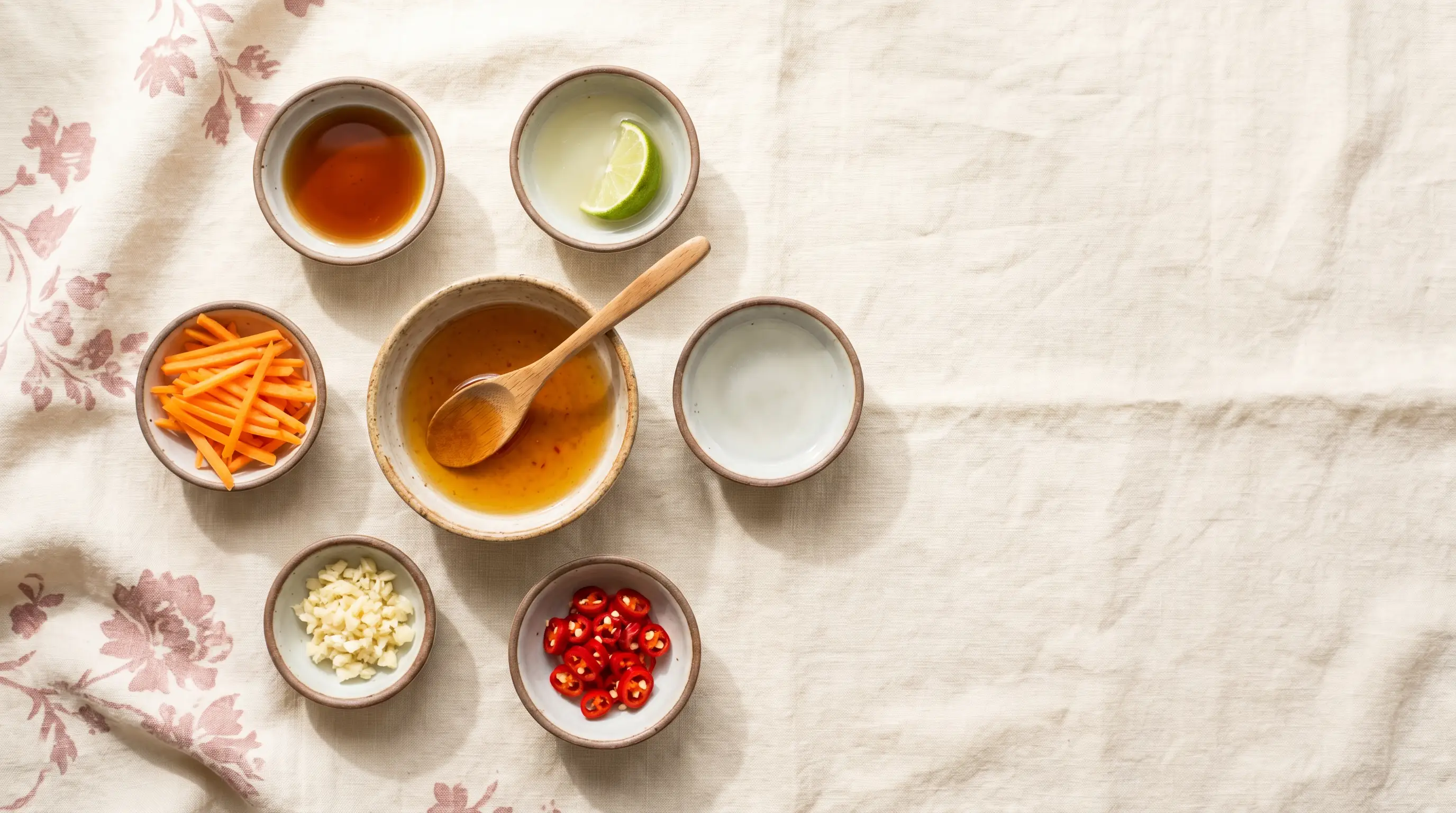
The three published ratios
If you read three serious published recipes, you'll get three different starting points:
- Andrea Nguyen (The Pho Cookbook, Vietnamese Food Any Day) — typically 1 part fish sauce, 1.5 parts lime juice, 2 parts sugar, 3 parts water. Sweet-forward.
- Vicky Pham (vickypham.com) — typically 1 part fish sauce, 1 part lime juice, 1 part sugar, 1 part water. Equally balanced.
- Hungry Huy (hungryhuy.com) — typically 1 part fish sauce, 2 parts water, 1 part lime juice, generous sugar to taste. More dilute, salt-leaning.
None of these is wrong. They're tuned to different fish-sauce brands, different dish pairings, and different family palates.
The variables that matter
Four things move the sauce more than ratios do:
- The fish sauce nitrogen content. 40°N nhỉ is much more salt-and-umami-dense than 20°N commercial sauce. If you switch brands, your ratio changes.
- The lime. Key limes are different from Persian limes. Bottled lime juice is different from fresh. Some bottles are cut with sugar.
- The sugar. Refined white sugar dissolves and disappears. Palm sugar adds caramel notes. Honey adds floral notes that some cooks like and others don't.
- The water. Dilution is the most underrated variable. A great dipping sauce is at the very edge of "this is too watery" — anything stronger reads as too aggressive on the palate.
Why family ratios drift
Vietnamese cooking has no equivalent of the Neapolitan pizza spec or the AOC system in France. Recipes are oral tradition, adjusted continuously to whatever ingredients are on hand. A grandmother in Saigon and a grandmother in Hanoi grew up with different fish sauces, different lime sizes, different sugar availability, and different dishes to dip in. Their ratios diverged across a century.
The Vietnamese diaspora compounded this. Vietnamese-American families in Texas use different fish-sauce brands than Vietnamese-Canadian families in Toronto. Different brands, different ratios.
What the dish wants
Nước chấm isn't one sauce — it's a category that shifts with the dish. The version that goes with bánh xèo (rich, fatty crepes) is more dilute and acidic. The version that goes with cơm tấm (broken rice plates) is denser and sweeter, almost like a glaze. The version inside bún (vermicelli bowls) is mid-range.
A single recipe can't serve all of those. Cooks who tell you they have "the" ratio are usually using one their family eats with their one most-common dish.
A reasonable starting point
If you're learning, start here:
- 2 parts warm water
- 1 part fish sauce (mid-range, ~30°N)
- 1 part fresh lime juice
- 1 part sugar
- Minced garlic and Thai chili to taste
Stir to dissolve the sugar. Taste. Adjust each variable one at a time. Don't double the lime AND add more chili AND extra fish sauce — you'll never figure out what changed.
The honest answer
If a Vietnamese grandmother tells you the right ratio, she's right — for her family, her ingredients, her dishes. If three cookbook authors give you three ratios, they're all right — for their target reader and target dish. Trying to find "the" canonical recipe is missing the point. The recipe is the household.
Ours
Our restaurant nước chấm is tuned to our menu, our fish sauce, and our specific lime supply. It changes seasonally — citrus shifts with the months. The base ratios aren't a trade secret, but the calibration is. Come try it with our vermicelli bowls or spring rolls at Taylorsville or West Jordan.