Technique · 4 min read
What Actually Happens When You Char Onion and Ginger for Phở Broth?
Every phở recipe demands it: blacken the ginger and onion over an open flame before they go in the pot. Andrea Nguyen calls it “a plausible Franco-Viet inheritance” from pot-au-feu technique. Most blog posts hand-wave the Maillard reaction. Nobody has actually run a blind tasting of charred-versus-raw aromatics in finished broth. So what do we actually know?
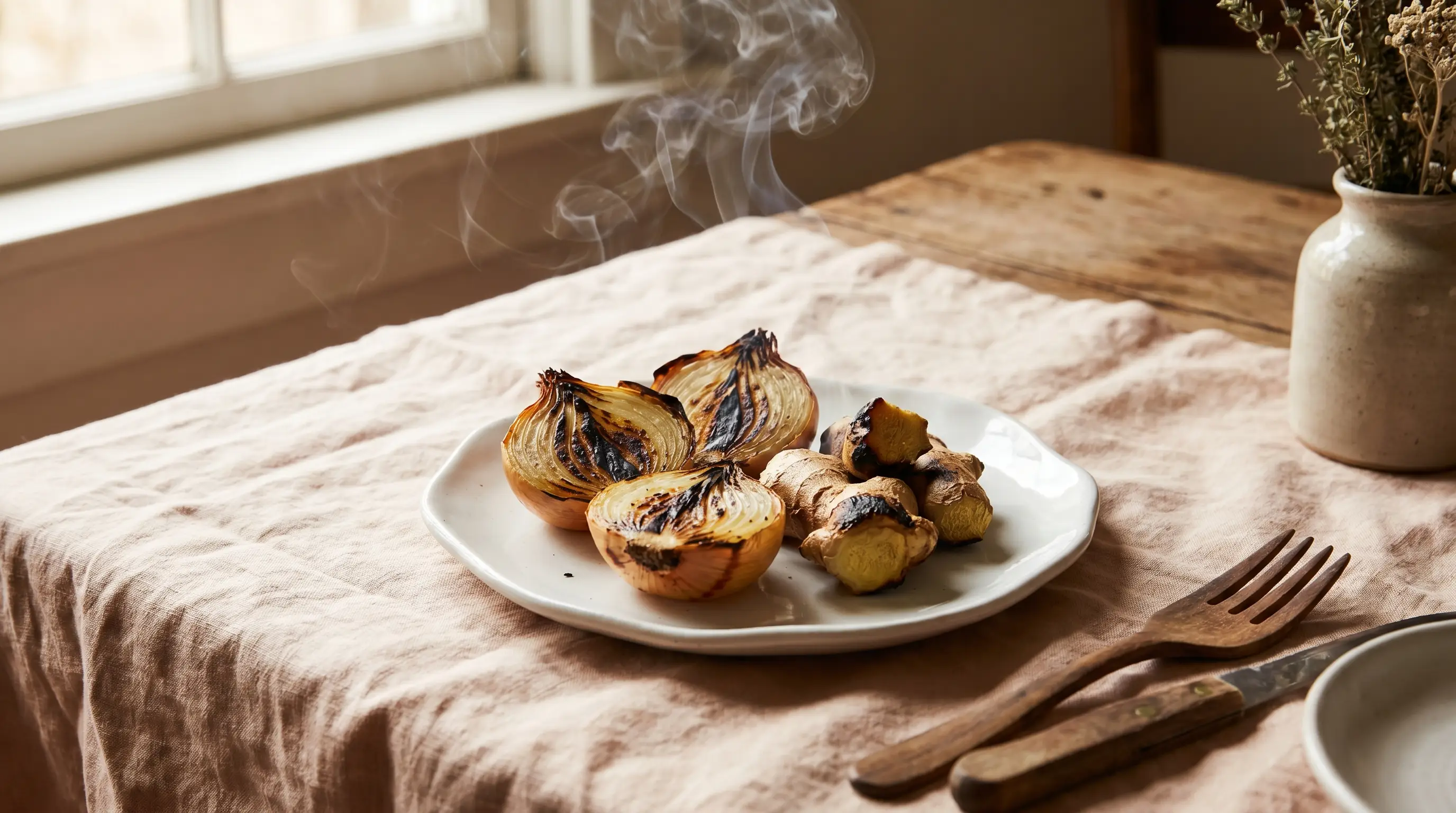
The Maillard reaction, in plain language
When you put a yellow onion half on an open flame, the surface hits 300-400°F within seconds. At that temperature, amino acids and sugars in the onion react to form hundreds of new compounds — pyrazines (which smell roasty), thiophenes (which smell sulfurous-savory), and caramelized sugars (which add a bittersweet edge). None of those compounds exist in raw onion. Boiling won't make them, either — water tops out at 212°F, well below Maillard territory.
Ginger goes through a parallel transformation. Gingerol, the pungent fresh-ginger compound, partially converts to zingerone (sweeter, less sharp) and shogaol (warmer, more rounded). The aroma profile shifts from bright-pungent to deep-rounded.
What this means for the broth
When you drop charred aromatics into the simmering pot, two things happen. First, the volatile aromatic compounds (the ones that just formed on the surface) extract into the liquid quickly — within the first hour. Second, the slightly bitter charred bits stay on the alliums themselves and continue contributing low-key bitter notes over the long simmer.
So the broth gets a layer of roasty, slightly-bitter complexity that you can't get by just throwing in raw onion. That's the chemistry. Whether you can taste it in a finished bowl, side by side with a control, is a different question.
Has anyone actually run the test?
Not that I can find. The pho-cookbook literature treats charring as ritual. The food-science literature has plenty of work on Maillard chemistry in alliums in general, but nothing specifically on pho broth.
It would be a straightforward experiment: make two batches of broth, identical except for the charring step, double-blind a panel of tasters. Nobody seems to have done it. The closest analog is Kenji López-Alt's various stock experiments at Serious Eats, which suggest aromatic treatment matters meaningfully in chicken stock — but he didn't specifically test pho.
The "Franco-Viet" theory
Andrea Nguyen has noted that the charring step lines up with classical French pot-au-feu technique — chefs in 19th-century French kitchens charred onions on the stove before adding them to bouillon. The technique made its way into Vietnamese pho via the same colonial pathway that brought beef to northern Vietnam in the first place.
If that's right, charring isn't ancient Vietnamese tradition. It's a 100-year-old French inheritance that became canonical. That doesn't make it less essential — it just makes it less mystical.
The skeptic's argument
You could argue that twelve hours of simmering with bones, spices, and skimming is doing 95% of the flavor work, and the charring step is the last 5%. You could argue that diners can't distinguish charred-aromatic broth from raw-aromatic broth blind. Both might be true.
The counter is: pho is a layered, balanced dish. The 5% is what makes it pho rather than "beef bone soup." Even small variables compound when you have a hundred other variables already tuned.
Why we still do it
Three reasons. First, the consensus across both Vietnamese family cooks and serious pho chefs is that charring matters, and we trust the accumulated kitchen wisdom even where the science hasn't caught up. Second, charring is fast — five minutes over an open flame for a sixty-quart pot of broth. The marginal effort is tiny. Third, the slight bitterness adds dimension to a broth that's otherwise sweet-savory, balancing the whole structure.
Could we serve good pho without it? Probably. Would we serve as good pho without it? We've never run the test, and we don't intend to.
How to do it at home
Halve a yellow onion. Cut a hand-sized piece of fresh ginger in half lengthwise (skin on). Place both cut-side down directly on a gas burner over high flame, or on a hot dry skillet, or under a broiler. Char until the surfaces are properly blackened in spots — six to eight minutes for a stovetop, less under a broiler. Rinse off any loose char and drop into the simmering pot.
If you want to taste the finished result, our pho is built on twelve hours of overnight broth and charred aromatics. Twenty-two variants, same base broth. Taylorsville and West Jordan.